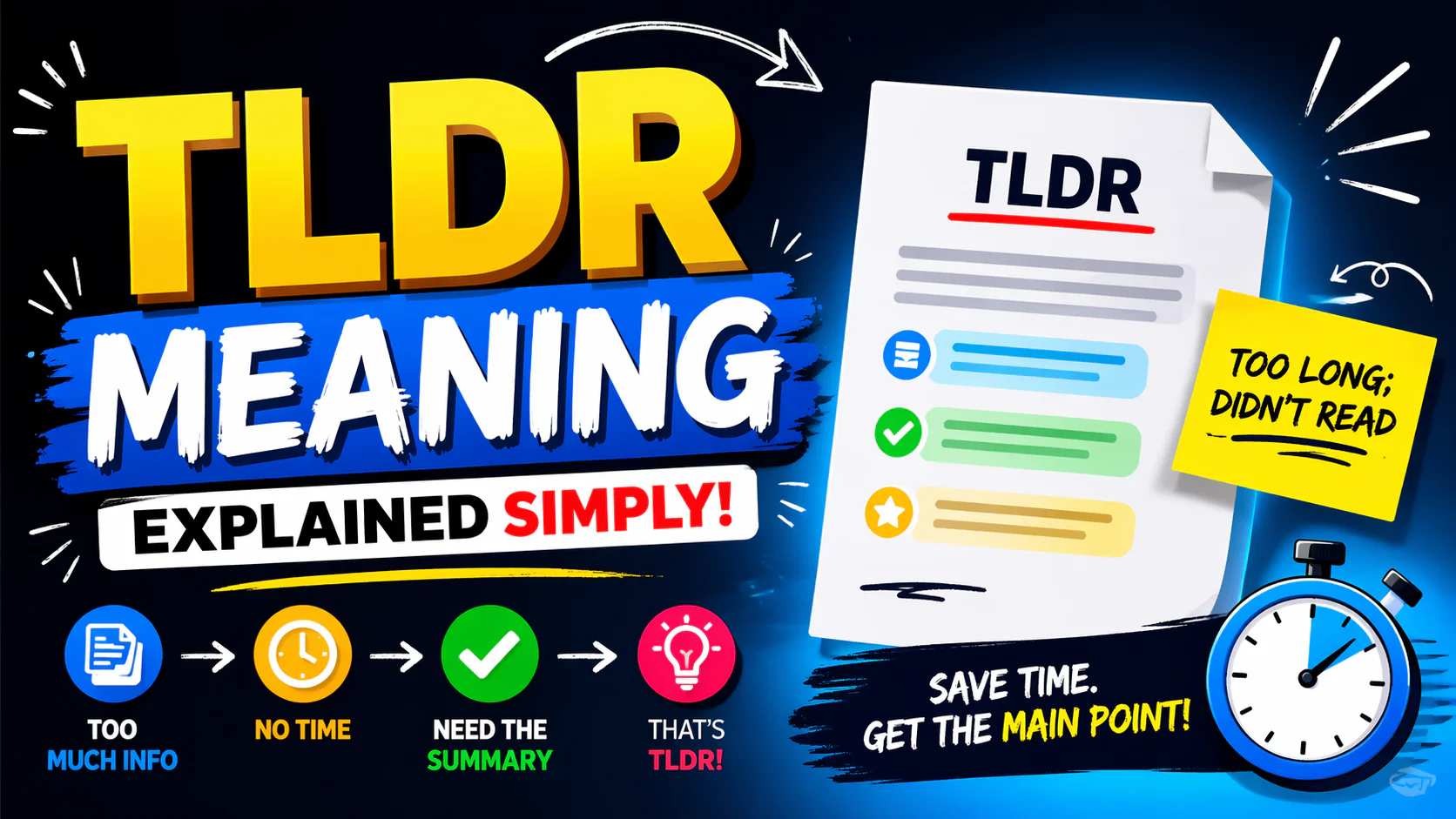
Discover the exact TLDR meaning and how to use it. This simple guide explains the popular internet slang to help you read and communicate much faster online today.
What Does TLDR Stand For?
The tldr meaning is very simple to remember for everyone. It stands for “Too Long; Didn’t Read.” People use this handy phrase when a text is extremely long. Instead of reading every single word, they want a brief summary. Think of it as a shortcut to the main point. If someone sends you a massive wall of text, you might ask for this quick version. It helps you skip the boring details. You get right to the core message without wasting any time at all.
Where Did This Phrase Come From?
This term started on early internet forums like Reddit. Users created the tldr meaning to save each other time. When someone wrote a huge essay, others would reply with this acronym. It quickly became a standard part of internet slang. Platforms like Wikipedia and Twitter helped make it famous. Today, it is everywhere in our digital culture. It grew because people are always busy. We all want fast answers in our fast-paced world. This little abbreviation solved a big reading problem for us.
How Do You Pronounce It?
You might wonder how to say this out loud. Most people simply say the letters “T-L-D-R.” However, some folks pronounce it like the word “teal-der.” Both ways are completely fine and widely accepted. Knowing the real history is much more important than how you say it. Whether you spell it out or say it as one word, people will understand you. It is a very flexible internet term. You can use it in casual chats without any worry at all in your daily life.
How to Use TLDR in Daily Texts
Using this phrase is incredibly easy and fun. You can put this helpful tag at the very start or end of your message. If you write a long email, put it at the top. This gives your reader a quick heads-up. You can also put it at the bottom to sum up your thoughts. Here are the best ways to use it in text messages:
- At the start of a long work email.
- At the end of a funny story.
- In group chats to sum up drama.
Real Examples of TLDR in Action
Seeing this phrase in action makes it much clearer. Imagine your friend sends a long text about their bad day. You can reply with the tldr meaning to show you get the point. For example, you might say, “TLDR: Your boss was mean.” This proves you understood the main idea. Another great example is in a business update. You can write a long report and add a quick summary at the end. People will really appreciate your clear communication skills.
Is TLDR Rude or Polite?
Many people worry about offending others with this acronym. The truth is that context depends on your tone. If you use it on a friend, it is totally fine. Friends do not mind a casual shortcut. However, you should avoid using it to your boss. In formal settings, it might look a bit lazy. To stay safe, you can use “TL;DR” with a smile. It keeps things light and friendly. Just think about who is reading your message first before hitting send.
What Are Good Alternatives to Use?
Sometimes you want a different way to give a quick summary. The core idea is great, but variety is always nice too. You can use phrases like “in short” or “to sum up.” These sound much more professional for work emails. Another good option is “the bottom line” for business. If you are talking to a younger crowd, “gist” works very well. All of these phrases do the exact same job. They help you share the main point without the extra fluff.
TLDR Meaning in Internet Culture Today
This acronym is a huge part of modern Gen Z communication. It perfectly shows how our reading habits have changed. We consume so much media every single day. We scan articles, skip videos, and scroll very fast. This little phrase captures our need for speed. It is a trust signal in digital spaces. When a creator gives a summary, we trust them more. It shows they respect our valuable time. It makes the whole internet feel much more manageable for everyone.
A Complete Detailing Table
TLDR Meaning
TL;DR (Too Long; Didn’t Read) Overview
| Feature | Description |
|---|---|
| Full Form | Too Long; Didn’t Read |
| Meaning 1 (Summary) | A short recap of a long article, email, or post. |
| Meaning 2 (Reaction) | A comment used to tell someone their post is too long to read. |
| Origin | Early 2000s internet forums (like Reddit and Usenet). |
| Placement | Usually at the very top (as a preview) or the bottom (as a conclusion). |
| Formal Alternative | Executive Summary, Abstract, or BLUF (Bottom Line Up Front). |
| Tone | Informal / Internet Slang. |
Usage Examples
| Context | How to Use It |
|---|---|
| Writing a Blog | “TL;DR: This phone has a great camera but poor battery life.” |
| In an Email | “I know this report is long, so here is the TL;DR version…” |
| Social Media | “Can someone give me a TL;DR of what happened in the match?” |
| As a Critic | “I’m not reading all that. TL;DR please!” |
Key Rules for a Good TL;DR
- Be Brief: It should only be 1–3 sentences max.
- Be Clear: Focus on the “What” and “Why” only.
- Stand Out: Use Bold or a box so it’s easy to find.
Why Summaries Matter for Your Brain
Giving your brain a break is very important for focus. When you use quick summaries, you protect your mental energy. Long texts can make you feel very tired and bored. A quick summary keeps your mind sharp and engaged. It helps you remember the most important facts. Experts say that short bursts of information are best. We learn better when things are simple. Using summaries is a smart way to stay informed. It keeps you from feeling overwhelmed by too much text.
How to Write a Perfect Summary
Writing your own quick recap is a great skill to build. To capture the true main point, you must strip away extra details. Focus only on the main action or the big outcome. Use short sentences to get your point across. Do not add your own opinions to the mix. Just state the bare facts as clearly as possible. Read the long text first, then close it. Try to write the core idea in just one single sentence. Practice makes this process very easy.
Conclusion
Understanding the tldr meaning is a huge step toward better online habits. It helps you cut through clutter and find the truth fast. You now know how to use it, spell it, and where to place it. You can start adding this helpful acronym to your own messages today. Your friends and coworkers will thank you for your clear writing. Take a moment to share this helpful guide with someone who needs it. Start saving time and communicating better right now!
FAQs
What is the tldr meaning in simple words?
The tldr meaning is simply “Too Long; Didn’t Read” in plain English. It is a popular internet abbreviation used to ask for a short summary. When you see a huge block of text, you can use this handy phrase. It tells the writer that you want the main point right away. People use it on social media, in text messages, and on forums. It saves you from reading boring or useless details. It is the perfect tool for fast and easy communication today.
Is it bad to use the tldr meaning at work?
Using the tldr meaning at work can be a bit risky. It depends entirely on your workplace culture. In a casual tech job, your boss might love it. In a strict office, it might look lazy or rude. To stay safe, you can write out “Summary” instead. You can also put a brief recap at the top of your email. This gives the same great result without using slang. Always think about your audience before you hit the send button today.
Does the tldr meaning have other spellings?
Yes, the tldr meaning has a few different ways to spell it. You will often see it written as “TL;DR” with a semicolon. Some people prefer to write it in all lowercase letters. Others might type it as “TLDR” without any punctuation. All of these versions mean the exact same thing. They all ask for a quick and easy summary of a long text. You can pick whichever style you like the best. The internet accepts all of these forms completely.
Can the tldr meaning be used as a joke?
People use the tldr meaning as a funny joke online all the time. Someone might write a very short sentence and then add “TLDR” at the end. This is a clever joke because the text was never long to begin with. It is a fun way to poke fun at people who complain about reading. You will see this ironic joke a lot on platforms like Reddit and Twitter. It adds a great layer of humor to very simple posts.
What is the opposite of the tldr meaning?
The exact opposite of the tldr meaning would be a deep dive or a long read. Instead of giving you a quick summary, it gives you all the details. If you want to say you read everything, you can use “TFR” or “Too Far; Read.” You might also just say “I read the whole thing.” Some people use “DFW” meaning “Didn’t Finish Writing.” These funny opposites play on the same internet slang style. They highlight the difference between skimming and reading closely.
Why do kids use the tldr meaning so much?
Younger generations use the tldr meaning because they value fast speed. Kids and teens grow up using apps like TikTok and Snapchat. These platforms train their brains to process information in seconds. They do not want to read a giant wall of text. This abbreviation perfectly fits their fast-paced digital lifestyle. It is quick to type and instantly understood by peers. It is simply a natural response to having too much information. They use it to stay focused and save time.