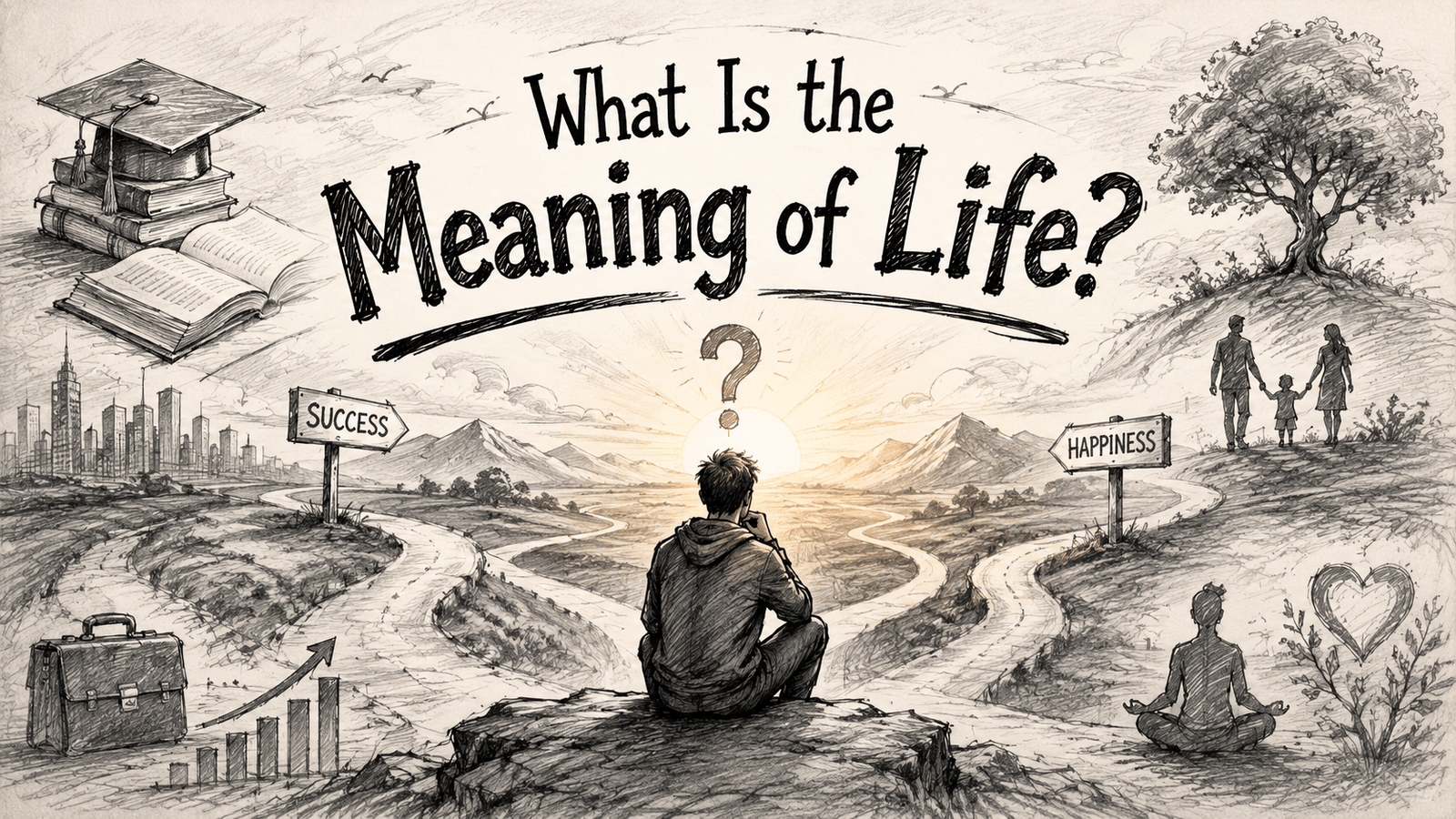
What Is the Meaning of Life? A Deep Dive Into Purpose, Faith, and Science
The One Question Every Human Asks
Some questions appear in every culture, every era, and every corner of the world. “What is the meaning of life?” is one of them. You’ll find it scratched into the margins of ancient philosophy texts, debated in theology classes, and typed into Google search bars millions of times a year.
And yet, despite centuries of inquiry, we still wrestle with it.
That is not a failure. It is a feature. The question endures because the answer is not one-size-fits-all — it is something each person must work out for themselves, shaped by their experiences, beliefs, and values.
This guide brings together insights from religion, philosophy, science, and psychology to help you think more clearly about purpose — and, more importantly, to help you start building it.
So, What Is the Meaning of Life? Here’s the Short Version
Across all major traditions of human thought, a surprisingly consistent picture emerges: life becomes meaningful when we love deeply, grow continually, and contribute to something beyond ourselves.
No single philosophy, religion, or scientific theory holds the complete answer. But together, they point in the same direction — toward connection, purpose, and a life lived in service of something greater than personal comfort or gain.
Five Major Perspectives on Why We’re Here
1. The Biblical View: Life Is Rooted in Love
For billions of Christians, the Bible provides a clear and deeply personal answer to life’s biggest question.
In the Gospel of Matthew (22:37–39), Jesus is asked which commandment is the greatest. His answer covers everything: love God with your whole being, and love your neighbor as yourself. This two-part instruction forms the moral backbone of Christian life.
Other books of the Bible add texture to this framework. Ecclesiastes, written in a voice of hard-won wisdom, cautions against placing your hope in wealth, achievement, or reputation. These things, the author observes, are fleeting — like chasing the wind. True satisfaction, the book argues, comes from a life aligned with something eternal: meaningful relationships and a purposeful walk with God.
For those who live within this framework, faith is not just a belief system — it is a daily compass, a source of comfort, and a community of belonging.
2. The Philosophical View: A Life of Virtue and Reason
Greek philosophy offers one of the oldest and most enduring answers to the question of purpose.
Aristotle, writing more than 2,000 years ago, argued that the highest human good is eudaimonia — a Greek word often translated as “flourishing” or “living well.” Crucially, Aristotle did not equate this with pleasure or success. He meant something deeper: a life lived with virtue, guided by reason, and oriented toward excellence in all that you do.
Centuries later, psychiatrist Viktor Frankl arrived at a similar conclusion through very different circumstances. A survivor of four Nazi concentration camps, including Auschwitz, Frankl observed that prisoners who maintained a sense of purpose — a reason to endure — were more likely to survive than those who lost hope. After the war, he built an entire school of psychotherapy around this insight, arguing that meaning can be found through three pathways: engaging in purposeful work, loving another person deeply, and choosing how we face unavoidable suffering.
His observation — that a person who has something to live for can endure almost any how — has resonated across generations and cultures.
3. The Scientific View: Remarkable Creatures on a Pale Blue Dot
From a purely biological standpoint, science describes life’s “purpose” as survival and reproduction. Evolution shaped us to pass our genes to the next generation. That is the engine behind much of our behavior.
But most people — scientists included — sense that this explanation, while accurate, is incomplete.
Human consciousness is extraordinary. We are the only known creatures who look up at the night sky and wonder how it all began. We write poetry, compose symphonies, build cathedrals, and grieve the deaths of people we have never met. We are made of atoms forged in dying stars, and yet we ask questions those stars never could.
Science does not strip life of meaning. If anything, understanding the sheer improbability of our existence adds a layer of wonder to it. Neuroscience and psychology have gone further, demonstrating that purposeful living, social connection, and contribution to others have measurable effects on mental and physical health. The science of meaning is real — and it matters.
4. The Psychological View: We Are Wired for Connection
Decades of research in positive psychology have consistently found that the people who report the greatest satisfaction with their lives share a few key traits: they have strong, meaningful relationships; they feel a sense of purpose in what they do; and they regularly contribute to the wellbeing of others.
These are not incidental findings. They reflect something deep in our biology.
Social belonging is not a luxury or a preference — it is a fundamental human need. Studies have found that chronic loneliness carries health risks comparable to smoking 15 cigarettes a day. On the other side, acts of generosity and service activate the brain’s reward systems in ways that money and status do not.
Purpose, in other words, is not just a philosophical ideal. It is physiological. It affects how long we live, how healthy we are, and how much we enjoy the time we have.
5. The Pop Culture Angle: What “42” Really Means
In Douglas Adams’ beloved comic science fiction novel The Hitchhiker’s Guide to the Galaxy, a supercomputer called Deep Thought spends seven and a half million years computing the ultimate answer to life, the universe, and everything. Its conclusion? The number 42.
The joke has delighted readers for decades — not because it mocks the search for meaning, but because it skewers the impulse to demand a neat, packaged answer to a question that resists simplification. Adams was pointing out that a lazy or vague question will always produce a useless answer. The real challenge is not finding the answer — it is learning to ask better questions.
“What Is the Meaning of Life?” is actually a starting point. The more useful questions are: What matters to me? What am I willing to give my time and energy to? Whose life am I making better?
A Side-by-Side Look at the Major Views
| Perspective | Central Idea | How It Shapes Daily Life |
|---|---|---|
| Biblical | Love God and love others | Community, service, faith, prayer |
| Philosophical | Live virtuously and reason well | Ethical choices, intellectual growth |
| Scientific | Conscious beings in a remarkable universe | Curiosity, environmental care, awe |
| Psychological | Connection and contribution are essential | Deep relationships, helping others |
| Existential | You create your own meaning | Clarifying personal values, chosen purpose |
How to Start Building Meaning in Your Own Life
Meaning is rarely discovered in a single moment of revelation. It tends to be constructed slowly, through choices made day after day. Here are some practical places to begin:
Notice what pulls you in. Pay attention to the activities, conversations, and causes that make you lose track of time. These are signals — not guarantees, but useful clues about where your energy naturally flows and where your strengths might lie.
Invest in the people around you. Research has consistently found that the quality of your relationships is one of the strongest predictors of long-term wellbeing — more reliable than income, status, or professional achievement. The people in your life are worth more of your attention than your to-do list.
Do something for someone else. Volunteering, mentoring, creating, caregiving — any act that improves another person’s experience of the world tends to reinforce your own sense of purpose. Service is not self-sacrifice. It is one of the most reliable sources of personal fulfillment.
Sit with the big questions. You do not need a definitive answer to live meaningfully. Philosophers have long argued that wrestling seriously with questions of purpose is itself a meaningful act. The search sharpens you.
Build habits that reflect your values. Meaning is not just a feeling — it is a practice. The routines and choices you repeat each day either align with what you believe matters or quietly drift away from it. Small, consistent decisions add up to a life.
Frequently Asked Questions
Is there one universally accepted answer to the meaning of life?
No, and that is by design. Different philosophical, religious, and scientific traditions offer different frameworks — and each contains genuine wisdom. What they share is a common thread: a meaningful life tends to involve loving others, continuing to grow, and contributing something beyond yourself. Your specific answer will be uniquely yours.
Why do people say “42” is the meaning of life?
This is a reference to Douglas Adams’ 1979 novel The Hitchhiker’s Guide to the Galaxy. In the story, a fictional supercomputer produces “42” as the answer to the ultimate question of existence after millions of years of calculation. Adams intended this as a satirical joke about the human desire for simple answers to profoundly complex questions — not as a genuine philosophical claim.
What does the Bible say about life’s meaning?
The Bible centers meaning on relationship — with God and with other people. Jesus summarized the entire moral law in two commands: love God wholeheartedly, and love your neighbor as yourself (Matthew 22:37–39). Ecclesiastes rounds this out by showing that wealth, achievement, and status ultimately feel hollow when they become ends in themselves. A life oriented toward God, meaningful relationships, and genuine service is portrayed as the path to true satisfaction.
Can science explain the meaning of life?
Science can describe how life works with remarkable precision, but it does not claim to determine why life matters in a moral or personal sense. Biologically, organisms are driven by survival and reproduction. But human beings have the unique capacity to reflect on those drives, transcend them, and assign personal significance to experience. What psychology and neuroscience can confirm is that purpose, connection, and contribution are associated with measurable improvements in both mental and physical health — giving science a real stake in the conversation.
Can you live a meaningful life without religious belief?
Absolutely. Philosophical traditions like Stoicism and humanism have long argued that a deeply fulfilling life is achievable through reason, strong relationships, and contribution to others — independent of any religious framework. Secular humanists ground meaning in human dignity, empathy, and the collective pursuit of wellbeing. Faith offers a powerful and time-tested path to purpose; it is not the only one.
What are the most meaningful quotes about life’s purpose?
A few thinkers have put it particularly well across the centuries. Aristotle argued that human flourishing — not pleasure or status, but genuine excellence in character — is the ultimate goal of existence. Viktor Frankl wrote that even in unimaginable suffering, a person retains the freedom to choose their response, and that meaning can be found in that very choice. Ralph Waldo Emerson believed that purpose is not something handed to us but something discovered through honest, courageous self-examination. All three point inward: meaning begins with clarity about who you are and what you truly value.
What if I feel lost and don’t know my purpose?
Start smaller than you think you need to. Purpose is rarely found in a dramatic epiphany — it is usually built through patient attention. Notice what moves you emotionally: what consistently angers you, excites you, or breaks your heart. These responses point toward what you value, even when your sense of direction feels unclear. From there, act on those values in small ways that benefit other people. Purpose tends to crystallize through action, not through waiting for the right moment.
The Bottom Line
The meaning of life is not a puzzle waiting to be solved. It is a living, evolving question — one that sharpens your thinking and deepens your character every time you take it seriously.
Whether your path runs through faith, philosophy, science, or simply the everyday love of the people around you, the direction is remarkably consistent: toward connection, growth, and something larger than yourself.
You do not need to have it all figured out before you begin. Start where you are. Act on what you care about. Let the meaning grow from there.