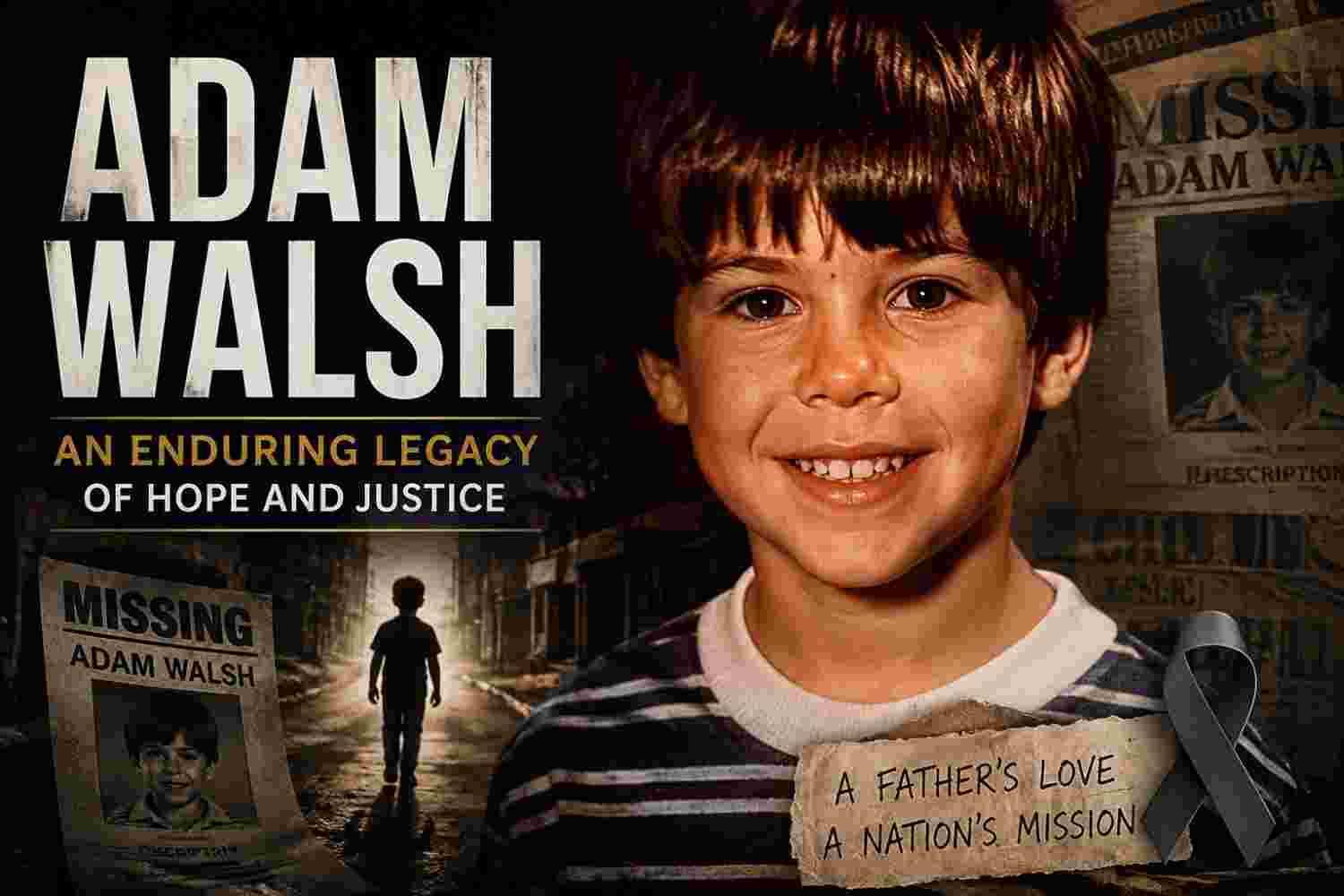
The disappearance of six-year-old Adam Walsh from a Florida mall in 1981 changed how the world responds to missing children. His father, John Walsh, turned unimaginable grief into a relentless crusade for justice. This movement forced law enforcement to abandon outdated protocols and treat every second as critical. The result created a safety net that has since rescued countless children from danger.
1. The Disappearance at the Hollywood Mall
On July 27, 1981, Revé Walsh took her son Adam to the Sears store at the Hollywood Mall in Hollywood, Florida. She allowed Adam to play a video game at a kiosk while she browsed the lamp department a few aisles away. They agreed to meet at that specific spot in just a few minutes.
When Revé returned, Adam was gone. The store lights flickered off, signaling closing time. Panic set in immediately. Initially, local police treated the case as a routine custody dispute or a runaway child. This delay in action would later become a central point of criticism and a catalyst for changing standard police procedures.
2. The Nationwide Search and the Discovery
In the days following the disappearance, a massive search operation unfolded across Florida. Volunteers and police officers scoured swamps, canals, and orange groves. John Walsh took to the news, pleading for his son’s safe return. The lack of a coordinated, rapid response system hindered early efforts.
Two weeks later, fishermen made a grim discovery in a drainage canal in Vero Beach, located over 100 miles north of the mall. On August 10, 1981, the remains were identified as Adam Walsh. Asphyxiation was determined to be the official cause of death The search shifted from a rescue mission to a hunt for a murderer.
3. The Prime Suspect: Ottis Toole
The investigation eventually honed in on a drifter and convicted serial killer named Ottis Toole. Toole confessed to the abduction and murder of Adam Walsh, claiming he drove the boy toward Vero Beach. However, Toole was notorious for giving false confessions. He later recanted his statement.
Evidence collection was mishandled in the early stages of the case. A critical piece of evidence—Adam’s severed head—was eventually lost by investigators. Without physical evidence tying Toole to the crime, and with a witness allegedly intimidated by Toole’s reputation, the case stalled. John Walsh pushed for answers for years, often clashing with law enforcement over their handling of the data.
4. The Official Closure of the Case
After decades of speculation and frustration, the Hollywood Police Department officially closed the Adam Walsh investigation in December 2008. Police Chief Chad Wagner announced that the evidence pointed overwhelmingly to Ottis Toole as the sole perpetrator.
John Walsh accepted the conclusion, stating that the “not knowing” had been the hardest part. The closure allowed the family to focus fully on advocacy rather than prosecution. Toole had died in prison in 1996 while serving time for other unrelated murders.
5. The Birth of “America’s Most Wanted”
John Walsh channeled his rage and sorrow into action. He recognized that criminals often crossed state lines to evade capture, and there was no central system for the public to help locate them. In 1988, Fox launched America’s Most Wanted, hosted by John Walsh.
The show revolutionized reality television and crime solving. Viewers could call in tips based on dramatic reenactments. Over its run, the program aided in the capture of over 1,200 fugitives and brought home more than 60 missing children. It proved the power of media in the fight for justice.
6. The Creation of the Missing Children Act
Before 1981, if a child went missing, their information was often not entered into the FBI’s national crime database. Police argued that only stolen property, like cars or guns, qualified for immediate entry. John Walsh discovered this loophole during his frantic search for Adam.
This revelation sparked John’s first legislative battle. The result was the Missing Children Act of 1982. This law mandated that data on missing persons be entered into the FBI’s National Crime Information Center (NCIC) immediately, without a mandatory waiting period. It ensured that missing children were treated with the same urgency as stolen vehicles.
7. The Adam Walsh Child Protection and Safety Act
In 2006, on the 25th anniversary of Adam’s disappearance, President George W. Bush signed the Adam Walsh Child Protection and Safety Act into law. This is one of the most aggressive pieces of child protection legislation in U.S. history.
The law established a national sex offender registry, organizing offenders into a three-tier system based on the severity of their crime. It mandated stricter reporting requirements for offenders and increased penalties for crimes against children. It also created a national standard for tracking sex offenders, closing state loopholes that allowed predators to disappear from the system.
8. The Code Adam Protocol
Out of tragedy came a practical, life-saving tool used in retail stores worldwide. “Code Adam” was developed by Walmart in 1994 and named in memory of Adam Walsh. It is a protocol activated when a child is reported missing inside a store.
When a Code Adam is announced:
- Employees immediately stop their normal tasks.
- All entrances and exits are monitored and locked down.
- A detailed description of the child is broadcast internally.
- If the child is not found within 10 minutes, law enforcement is contacted.
This protocol has been adopted by malls, museums, amusement parks, and government buildings across the globe.
9. The National Center for Missing & Exploited Children
John and Revé Walsh co-founded the National Center for Missing & Exploited Children (NCMEC) in 1984. The center became a clearinghouse for information and a resource for parents in crisis. It works hand-in-hand with the Department of Justice.
NCMEC operates the CyberTipline, which has processed millions of reports of child sexual abuse material. They also employ forensic artists to age-progress photos of long-term missing children. Their recovery rate for missing children has risen from roughly 60% in the 1980s to over 90% today.
10. The Lasting Impact on Law Enforcement
The legacy of Adam Walsh forced a fundamental shift in police culture. Officers are now trained to assume the worst immediately, treating every missing child report as a potential abduction. “The first 48 hours are critical” is a mantra born directly from the failures of the 1981 investigation.
Key Changes Inspired by the Case:
- Immediate Response: Police cannot enforce a 24-hour waiting period before starting a search.
- Cross-Jurisdictional Cooperation: State and federal agencies now share data instantly.
- Public Engagement: The media is viewed as a partner, not an obstacle, in locating children.
Frequently Asked Questions
Question 1: What happened to the Adam Walsh murder weapon?
The murder weapon was never definitively identified or recovered. Investigators believe Ottis Toole used a machete, but due to the significant loss of physical evidence by the Hollywood Police Department—including the car Toole was driving and the rug from the vehicle—the exact tool used in the homicide of Adam Walsh could not be conclusively confirmed in court.
Question 2: Why did it take 27 years to close the Adam Walsh case?
The case remained open for 27 years due to a combination of mishandled evidence and unreliable confessions. The Hollywood Police Department admitted to losing critical forensic evidence early in the investigation. Furthermore, Ottis Toole’s tendency to recant his statements made it difficult to secure a prosecution without physical proof linking him to the crime.
Question 3: How many children has the Code Adam program saved?
While it is impossible to calculate an exact number of “saves,” the Code Adam protocol has located thousands of missing children in the moments immediately following their separation from parents. The program is designed to stop an abduction in progress before the child leaves the premises, making it one of the most effective retail safety protocols in existence.
Question 4: What is the Adam Walsh Act registry classification?
The Adam Walsh Act standardizes sex offenders into a three-tier system.
- Tier I: Lowest tier, usually non-violent offenses.
- Tier II: Mid-tier offenses, requiring registration for 25 years.
- Tier III: Most severe offenses, requiring lifetime registration with verification every three months.
Question 5: How did Adam Walsh change missing child posters?
Prior to Adam Walsh, there was no immediate national distribution system for missing child flyers. John Walsh’s advocacy led to the use of satellite technology and national databases where a single poster could be broadcast to police stations and media outlets nationwide instantly, rather than relying on slow postal mail or fax chains.
Question 6: Where is the Adam Walsh memorial located?
There are multiple memorials dedicated to Adam Walsh. The most significant is the memorial garden located at the Hollywood Police Department in Florida, dedicated to his memory. Additionally, many child safety centers across the United States bear his name as a symbol of hope for the safe recovery of other children.
Conclusion: The Call to Remain Vigilant
The world lost Adam Walsh, but the systems created in his name have brought home thousands of other sons and daughters. The fight for child safety is ongoing, requiring new technology and constant vigilance. You can honor this legacy by memorizing the Code Adam protocol, supporting NCMEC, and never looking away from a missing child poster. The responsibility to protect the innocent belongs to every one of us.