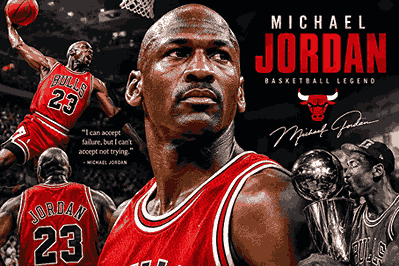
Michael Jordan did more than win basketball games. He turned elite competition into a global spectacle, built one of the most recognizable athletic identities in history, and helped make the NBA a worldwide cultural force. His career combines extraordinary scoring, six championships, five regular-season MVP awards, six Finals MVP awards, Olympic success, and a level of competitive intensity that still shapes basketball discussions today.
Who Is Michael Jordan?
Michael Jordan is a former American professional basketball player best known for his legendary career with the Chicago Bulls. Born on February 17, 1963, in Brooklyn, New York, he eventually became one of basketball’s defining figures.
The Naismith Basketball Hall of Fame lists him as a six-time NBA champion, six-time Finals MVP, five-time NBA MVP, 14-time All-Star, nine-time All-Defensive First Team selection, and 10-time All-NBA First Team selection.
His influence also reached far beyond statistics. His playing style, competitive personality, signature number 23, and Air Jordan brand helped turn him from a basketball superstar into a global sports icon.
Michael Jordan Quick Facts
| Category | Details |
| Full Name | Michael Jeffrey Jordan |
| Born | February 17, 1963 |
| Birthplace | Brooklyn, New York |
| Position | Guard |
| Height | 6’6″ |
| College | University of North Carolina |
| NBA Draft | 1984, 1st Round, 3rd Pick |
| Main NBA Team | Chicago Bulls |
| Other NBA Team | Washington Wizards |
| NBA Championships | 6 |
| NBA Finals MVP Awards | 6 |
| NBA MVP Awards | 5 |
| NBA All-Star Selections | 14 |
| Career Scoring Average | 30.1 points per game |
| Hall of Fame | Inducted in 2009 |
NBA records his career scoring average at 30.1 points per game, along with 6.2 rebounds and 5.3 assists per game.
How Did Michael Jordan Start His Basketball Career?
Jordan’s path to basketball greatness was not effortless. His development accelerated during high school, and he eventually earned a place at the University of North Carolina.
At North Carolina, he quickly became a major talent. During his freshman season, he hit the game-winning shot in the 1982 NCAA championship game against Georgetown, creating one of the earliest defining moments of his career.
His college success helped establish him as an elite NBA prospect.
When Did Michael Jordan Enter the NBA?
Michael Jordan entered the NBA in 1984 after leaving North Carolina following his junior season. The Chicago Bulls selected him with the third overall pick in the NBA Draft.
He immediately made an impact. Jordan won Rookie of the Year and became an All-Star during his first NBA season, beginning a career that would transform the Chicago Bulls and the league itself.
Why Was Michael Jordan So Dominant?
Jordan combined several elite skills rather than depending on one strength.
His game included:
- Explosive athleticism
- Exceptional scoring ability
- Strong defensive instincts
- Creative footwork
- Mid-range shooting
- Powerful drives to the basket
- Outstanding competitiveness
- Ability to perform under pressure
His athletic ability made spectacular plays possible, but his technical skill gave him consistency. That combination separated him from many other high-level players.
Michael Jordan’s Rise With the Chicago Bulls
Jordan’s early years with the Bulls included individual brilliance but also difficult playoff defeats. The Detroit Pistons repeatedly stopped Chicago in the late 1980s, forcing the Bulls to become tougher and more complete as a team.
The arrival of coach Phil Jackson and the development of teammates such as Scottie Pippen helped change the Bulls’ trajectory. Chicago eventually broke through in 1991.
That breakthrough began the first of Jordan’s two championship three-peats.
How Many NBA Championships Did Michael Jordan Win?
Michael Jordan won six NBA championships, all with the Chicago Bulls.
His championship seasons were:
| Season | Opponent in NBA Finals | Result |
| 1990–91 | Los Angeles Lakers | Bulls won |
| 1991–92 | Portland Trail Blazers | Bulls won |
| 1992–93 | Phoenix Suns | Bulls won |
| 1995–96 | Seattle SuperSonics | Bulls won |
| 1996–97 | Utah Jazz | Bulls won |
| 1997–98 | Utah Jazz | Bulls won |
Jordan was named Finals MVP in all six championship runs, a record that remains central to his postseason legacy.
The Bulls’ first three championships came from 1991 through 1993. After Jordan returned from his first retirement, Chicago won three more consecutive titles from 1996 through 1998.
How Many MVP Awards Did Michael Jordan Win?
Jordan won five regular-season NBA MVP awards.
His MVP seasons were:
- 1987–88
- 1990–91
- 1991–92
- 1995–96
- 1997–98
During the 1987–88 season, he also won Defensive Player of the Year, showing that his impact extended beyond scoring.
The combination of five regular-season MVP awards and six Finals MVP awards makes his individual résumé especially impressive.
What Are Michael Jordan’s Career Statistics?
Jordan finished his NBA career with a 30.1 points-per-game scoring average, the highest career scoring average listed by the NBA. In addition, he averaged 5.3 assists and 6.2 rebounds per game.
His career totals with the Bulls include:
| Statistic | Bulls Career Total |
| Points | 29,277 |
| Rebounds | 5,836 |
| Assists | 5,012 |
| Steals | 2,306 |
| Championships | 6 |
The official Chicago Bulls team information lists Jordan as the franchise’s all-time leader in points, assists, rebounds, and steals.
Did Michael Jordan Play Baseball?
Yes. Jordan temporarily left professional basketball after the 1992–93 season and pursued professional baseball.
The Hall of Fame records that he played minor-league baseball before returning to the NBA full-time in 1995.
His return immediately restored him to the center of the NBA. The Bulls went on to win another three championships, beginning in the 1995–96 season.
What Was Michael Jordan’s Greatest NBA Season?
The answer depends on what you value most.
From a team perspective, the 1995–96 season stands out. Jordan returned from his first full season back in basketball and led Chicago to an NBA championship while winning the regular-season MVP and Finals MVP. The Bulls also finished the regular season with 72 victories, a record at the time.
From an individual-statistical perspective, other seasons provide equally strong arguments. His 1987–88 campaign included the regular-season MVP and Defensive Player of the Year awards.
Michael Jordan and the 1992 Olympic Dream Team
Jordan was also part of the legendary 1992 U.S. Olympic men’s basketball team in Barcelona.
The team went undefeated at 8–0 and won Olympic gold. It was the first U.S. Olympic basketball team to include NBA players and featured a collection of Hall of Fame-level talent.
Jordan’s presence alongside players such as Magic Johnson, Larry Bird, Scottie Pippen, Charles Barkley and Patrick Ewing helped make the team one of the most famous basketball groups ever assembled.
Why Did Michael Jordan Become a Global Icon?
Jordan’s influence reached beyond the basketball court.
His combination of elite performance, memorable moments, distinctive style, and commercial success created a model for the modern sports superstar. The NBA itself describes his influence as extending beyond championships and awards into globalizing the league and establishing him as a cultural icon.
The Air Jordan sneaker line became another major part of that cultural impact. His name became associated not only with basketball but also with sports fashion and athletic marketing.
Michael Jordan’s Playing Style
Jordan’s playing style evolved throughout his career.
Early in his career, athletic drives and spectacular finishes were major parts of his game. As defenses adjusted, he developed a highly effective mid-range game, improved his decision-making, and became increasingly comfortable creating shots from different areas of the court.
His defensive ability also deserves attention. Jordan earned nine All-Defensive First Team selections and won Defensive Player of the Year in 1988.
That balance between offense and defense helps explain why his career remains so influential.
Michael Jordan’s Most Important Career Milestones
A simplified timeline shows how quickly his career developed:
- 1963: Born in Brooklyn, New York.
- 1982: Hits the winning shot in the NCAA championship game.
- 1984: Selected third overall by the Chicago Bulls.
- 1985: Wins NBA Rookie of the Year.
- 1988: Wins MVP and Defensive Player of the Year.
- 1991: Wins his first NBA championship and Finals MVP.
- 1992: Wins another NBA championship and Olympic gold.
- 1993: Wins his third consecutive NBA title before retiring from basketball.
- 1995: Returns to the NBA.
- 1996: Wins another championship and MVP.
- 1997: Wins his fifth championship.
- 1998: Wins his sixth championship and sixth Finals MVP.
- 2001: Returns to the NBA with the Washington Wizards.
- 2003: Finishes his NBA playing career.
- 2009: Enshrined in the Naismith Basketball Hall of Fame.
The Hall of Fame confirms his Bulls and Wizards career history and his 2009 induction.
Michael Jordan’s Legacy in Basketball
Jordan’s legacy rests on more than a list of awards.
He became the standard many fans use when discussing basketball greatness. His career also helped push the NBA toward a broader international audience, while his competitive identity influenced how athletes presented themselves both on and off the court.
The numbers reinforce that legacy: six championships, six Finals MVP awards, five regular-season MVP awards, 14 All-Star selections, and a 30.1 career scoring average.
At the same time, his career provides a useful lesson about sustained excellence. Jordan faced playoff setbacks before winning his first championship, returned after retirement, and continued competing at an elite level.
Michael Jordan vs. Other Basketball Legends
Comparing all-time players requires more than counting championships. Different eras, positions, teammates, rules, competition, and responsibilities can change how statistics should be interpreted.
A useful comparison should therefore consider:
- Individual production
- Championships
- Playoff performance
- Defense
- Longevity
- Leadership
- Era
- Influence on basketball
- Cultural impact
Jordan’s case remains especially strong because he combined elite scoring with defense, team success, individual awards, and enormous cultural influence.
What Can Young Athletes Learn From Michael Jordan?
Jordan’s career offers lessons that apply beyond basketball.
1. Skill requires repetition
Natural ability matters, but elite performance requires constant practice and refinement.
2. Setbacks can become turning points
Jordan experienced difficult playoff losses before reaching championship success. Those experiences became part of his development.
3. Team success matters
Individual talent did not win Chicago’s championships alone. The Bulls became champions through the combined work of Jordan, Pippen, their teammates, coaches, and organization.
4. Adaptability creates longevity
Jordan changed parts of his game as his career progressed. That ability to adapt helped him remain effective.
5. Excellence requires consistency
Great performances attract attention, but repeated high-level performance creates a lasting legacy.
Why Does Michael Jordan Still Matter Today?
Decades after his most famous NBA seasons, Jordan remains part of basketball’s central conversation.
His statistics remain extraordinary, his six championship runs remain highly memorable, and his influence on sports culture continues through the Jordan brand and the generations of players who grew up watching him.
The strongest reason his name remains relevant is simple: his career created a standard that basketball fans still debate, study, and measure against.
Frequently Asked Questions About Michael Jordan
1. How many championships did Michael Jordan win?
Michael Jordan won six NBA championships with the Chicago Bulls. He also won Finals MVP in every one of those six championship series.
2. How many MVP awards did Michael Jordan win?
He won five NBA regular-season MVP awards and six Finals MVP awards.
3. What was Michael Jordan’s career scoring average?
His career NBA scoring average was 30.1 points per game, which the NBA lists as the highest career scoring average.
4. Which team drafted Michael Jordan?
The Chicago Bulls selected Jordan third overall in the 1984 NBA Draft.
5. Did Michael Jordan win an Olympic gold medal?
Yes. Jordan was part of the U.S. men’s basketball team that won gold at the 1992 Barcelona Olympics.
6. When was Michael Jordan inducted into the Basketball Hall of Fame?
Jordan was inducted into the Naismith Basketball Hall of Fame in 2009.
Final Thoughts: Why Michael Jordan’s Story Still Inspires
Michael Jordan’s career shows what happens when extraordinary ability meets relentless competition, preparation, adaptation, and the willingness to keep improving.
His six championships tell only part of the story. His five MVP awards, six Finals MVP awards, defensive achievements, Olympic success, scoring record, and lasting cultural influence complete a career that changed basketball forever.
For athletes, fans, and anyone chasing excellence, his story offers a powerful reminder: greatness is not built from one unforgettable moment. It is built by repeatedly demanding more from yourself and delivering when the pressure is highest.
The most valuable way to understand Michael Jordan is not simply to ask whether he was the greatest. Study the career, examine the numbers, watch the performances, understand the setbacks, and decide what his legacy means to you.